

Authors #
Emeritus Professor Ann Williamson, University of New South Wales
Emeritus Professor Barry Watson, Queensland University of Technology (QUT), MAIC-QUT Road Safety Research Collaboration
Emeritus Professor Michael Regan, University of New South Wales
Professor Joanne Bennett, Australian Catholic University
Reviewers #
Mohd Kairul Alhapiz Ibrahim, Road User Behavioral Change Research Center, Malaysian Institute of Road Safety Research
Dr Soames Job, Global Road Safety Solutions Pty Ltd
Abstract #
This second chapter on the Users of the road system focusses on the role of error and risk-taking behaviour in road safety. The objective of the first chapter was to describe the role of the human user in the road transport system and to explain why, through understanding how humans behave and perform in the road system, road user error can be avoided. This second chapter expands on the first, through exploring in greater detail the influence of error in road safety and tackles the role of risk-taking behaviour. The chapter covers different perspectives of error that road safety can borrow from other transport sectors like aviation, as well as discussing more about the nature of error. This includes how it is defined, when error is most likely, different types of error and the relationship between skill development and error management. The chapter looks at the role of intention in defining behaviour as errors, especially deliberate risk-taking behaviour and violations of road safety rules, and contrasts these with unintended risky behaviour. It also looks at the factors that increase risky behaviour and the evidence linking risky behaviour and crashes. Together these two chapters aim to show how, through understanding human information processing and behaviour, the nature and likelihood of errors, and the role of risky and risk-taking behaviour, creates a critical foundation for improving road safety by preventing crashes in addition to limiting the severity of their consequences. Error is often a by-a product of poor system design, and preventing and managing it is a shared responsibility by all parties. We need to acknowledge this and take the action required in order to improve safety in the road system.
1. Introduction #
In the first chapter on the User in the road safety, we covered road user behaviour and performance and summarised current thinking on how humans process information, and the human capacities and limitations we might expect from users in settings like the road system. The chapter also described the range of factors that can disrupt human information processing and adversely influence road user behaviour more generally. Through understanding the origins of human behaviour and the factors that can adversely affect it we are in a stronger position to create situations and circumstances in the road system that avoid human limitations and the errors that occur as a result. When a road user error is involved in a crash, however, it is often not clear why it occurred. In fact, most often error is noted as a crash cause, but no further analysis occurs. This means we miss opportunities to address situations and circumstances that contributed to the error occurring.
The objective of this second chapter on the User in road safety is to describe the role of error in road safety. This includes comparison of perspectives on the role of error in road safety and other sectors, how error is defined and different categories of error, influences on the likelihood of error and the relationship between error and skill development. The chapter also looks at error and the influence of intention especially the role of risky behaviour, risk-taking and violations in causing crashes as well as the factors that increase risk-taking behaviour. In covering this important issue in road safety, we must acknowledge that prevention and management of error is a shared responsibility for all stakeholders in road safety.
2. Current perspectives of the role of error in road safety #
Road user error is commonly assumed to be one of the main factors contributing to road crashes. Current models of road safety, including the Safe System Approach and Vision Zero, begin with the principle that road user error is inevitable. Multiple studies over the past fifty years have attributed crashes to a single causal factor, the road user. Studies across the world and across time have ventured similar statistics for the role of the road user as a cause or contributing factor in crashes. Early studies in the UK in 1975 and in the USA in 1977, for example, identified the road user as sole or contributing factor in 95% and 94% of crashes, with other factors like the road environment reported as causes much less frequently (31% and 27%, respectively) (Oppenheimer and Shinar, 2011). More recent US studies cite similar findings. Results from the SHRP2 naturalistic driving study (Dingus et al., 2016) concluded that human failure occurred in 88% of crashes. In addition, the national motor vehicle crash causation survey conducted by NHTSA (Singh, 2015) concluded that drivers were the critical reason for 94% of crashes involving light vehicles.
These conclusions have been challenged, however, on the basis that crashes almost never involve just a single cause or factor and that the most proximal cause, occurring immediately before the crash, would always be biased toward road user behaviour as other potential factors like the road layout or environment tend to be pre-existing and more static (Shinar, 2019; Hauer, 2020). This is leading to some rethinking of the role of road user behaviour in crashes. In fact, the Singh paper mentioned above was republished in 2018 with the added caveat that:
‘It is important to note that the pre-crash assessment of crashes in terms of the critical event, critical reasons, and associated factors is neither suggestive of the cause of the crash nor of a fault to the driver, vehicle, or environment’ (Singh, 2018).
Further, more recent in-depth studies of the causes of crashes (eg., Fitzharris et al., 2020; Doecke et al., 2020; Wundersitz and Raferty, 2025) identify a much greater range of causal and contributing factors in crashes such as visibility of a key part of the road or infrastructure and road layout in addition to behaviours that are judged as error, like poor speed choice. These studies also highlight the possibility of a broader range of interventions, including improving roads and vehicle technology, that have the additional benefit of preventing as well as mitigating the consequences of crashes.
Further, many of the early in-depth studies treated road user error as an amorphous entity, with different types of unintentional errors and risky and intentional behaviours all grouped together under the general heading of “errors” (eg., Reason, 1990; Woods et al., 2010). This has obscured the different mechanisms and influences underpinning unintentional error and intentional risk taking and consequently led again to limiting the range of possible interventions to reduce error in the road system.
3. Perspectives from other transport and related sectors #
Other sectors where safety is of concern, like the workplace and transport sectors such as aviation and rail, have made significant advances in analysis of the nature, circumstances and causes of error. Road safety can learn from how error is conceptualised and treated in these sectors. These sectors acknowledge that the system is complex, and single causes are insufficient explanations of crashes or failure. This was illustrated by Reason’s well-known latent failure or Swiss cheese model of system failure (Reason, 1997). This model acknowledges that accidents or disasters do not occur due to a single failure or error, but because of a concatenation of multiple smaller failures and contributing factors. This model has been highly influential in thinking about safety and the human contribution, including error (Reason, 2008).
In areas like aviation for example, error is seen as a symptom of vulnerabilities in other, deeper, parts of the system rather than the cause of the failure (ICAO, 2018). In the road system, error should be considered in the same way as an indicator that other aspects of the system are creating vulnerabilities for human performance. Strategies like Black Spot programmes are a partial attempt to do this, but they often fail to consider why the error occurs in that context, focussing more on limiting the severity of crashes in the particular location. The following discussion of the role of error in road safety will borrow from evidence from these other sectors where it helps explain crash causation and prevention as well as from road safety.
4. Defining error #
There are many definitions of error, but they share the idea that an error is a human action, physical or mental, that is contrary to intention. Whether a behaviour is judged to be an error depends on the context in which it occurs. Some behaviours that are correct or acceptable in one setting may be an error in another. For example, taking eyes off the road to check your navigation system would not be judged an error in a critical incident, but the same action to check your mobile phone while driving would be judged an error even if there is no adverse outcome.
Some behaviours that might be judged to be an error may have desirable outcomes such as swerving into an adjacent lane to avoid debris or a pothole on the road. Unsafe outcomes like crashes are not always due to incorrect behaviour or error, and failure to achieve a goal when driving, like being safe, is not always due to error. Factors relating to poor or confusing road design or signage, poor user-centred design of vehicles, traffic congestion or the behaviour of other road users for example can make safe driving difficult leading to incorrect behaviour and unintentional errors.
Some incorrect or error behaviours are inherent in the task and so cannot be judged as error. For example, keeping your vehicle within your lane in gusty winds will lead to oversteering which must be corrected to stay in lane. The driving task involves adjusting steering behaviour in response to the disruption to the vehicle path in a timely way, so the overall intention to stay in lane is achieved. In many settings, errors provide information about overall performance. Errors are an integral and beneficial part of training and the development of skills. Problem solving and creativity is defined by trial and error, as errors provide feedback on correct and incorrect behaviour and so are helpful in shaping behaviour. Errors, therefore, are not intrinsically bad, and are essential for learning in novel situations.
5. The likelihood of errors #
Errors are not random and do not occur unexpectedly but can be repetitive and take predictable forms. Different errors occur in different situations. For example, skilled or habitual behaviour which is largely automatic, and unconscious can be particularly prone to what have been called slips or actions-not-as-planned or to memory lapses (Reason, 1990). Examples in driving include common errors like turning on the wipers instead of indicator when driving a different car, forgetting to turn on head lights or failing to notice that they were not on, or missing, an exit on the highway. Errors are also likely when human attentional resources are overloaded such as when trying to navigate an unfamiliar route in a high-speed tunnel or when attention is taken up by extraneous activities or by distractions such as a phone ringing or child passenger crying while driving (Hole, 2007). Errors are also more common when expectations or experiences and knowledge held in long term memory influence behaviour contrary to the situation at hand (Hole, 2007). In driving this occurs, for example, when drivers fail to notice a modification to aspects of the road system like a change to the speed limit or a new deviation in their usual drive to work and behave as they are used to doing rather than adapting their behaviour to the new circumstances.
Errors do not occur only because of failures in human information processing. Our world, including the road system, contains situations that create errors. Norman’s well-known book The Psychology of Everyday Things (but since revised into The Design of Everyday Things) (1988) pointed this out very clearly. He showed how the design of even everyday objects like doors can promote error when designers fail to account for how humans process information and our expectations about how objects used in everyday life operate. Redesigning these everyday objects through user-centred design can make them easier and more error-free for users. The same principles apply to designing for the road system. A similar concept of error traps was recognised by Reason (2008), where particular situations create errors for most people that encounter them. In the road system there are many examples where the circumstances rather than individual failings increase the likelihood of error. These can include confusing design of road signs and lane markings or driver assistance features like convex side mirrors that give drivers false information about the relative difference of the vehicle in the adjacent lane (see Williamson, 2021 for examples).
6. Categories of error types #
A wide range of types of error have been distinguished, and several taxonomies are in use based on different task and conceptual frameworks (Reason, 2008). Some of the most widely recognised frameworks relate to the cognitive origins of the error (Rasmussen, 1983). In these frameworks errors are categorised by the level of cognitive processing involved:
- Skill-based errors, often called Slips and lapses are errors in routine behaviour requiring little conscious control and resulting from failure in the execution of a sequence of actions (a slip) or where some aspect is forgotten (a lapse). These errors occur when the person knows what they are doing and in fact may be highly skilled in the behaviour, such as driving. In these errors the action is unintended and often surprising to the person. Mostly the slip or lapse results in unintended outcomes like crashes, but sometimes this is avoided, resulting in a lucky miss. For example, a driver who misjudges the gap when turning into a fast-moving stream of traffic (a slip) will hit the passing vehicle, but if the other driver can brake fast enough, the crash might be avoided.
- Rule-based Mistakes are errors where although the behaviour is not skilled, there are known rules or established patterns for the behaviour. Mistakes occur when a person applies a rule as they intend, but the outcome is not as intended since the rule had been misapplied or was inappropriate in the circumstances. Examples when driving can include failing to comply with a lowered speed limit around a school or pedestrian zone because the road is a dual lane divided highway which the driver judges to indicate a higher speed or failing to yield to other vehicles or pedestrians at an intersection unintentionally when required by law or signage.
- Knowledge-based Mistakes are errors occurring in novel situations or the task is novel, so behaviour is often chosen by trial and error. In these types of circumstances, we should expect frequent errors, but these errors can be beneficial as they help us learn about appropriate behaviour. In road settings, these types of errors are avoided by requiring drivers to have at least a degree of skill before being allowed to drive independently and through establishing rules of the road which guide drivers on use of the road system. Nevertheless knowledge-based errors still occur in the road system. For example, in situations like new sections of road with poor or inadequate signage about routes or how the new road should be used. In such circumstances drivers tend to behave as they usually do or as they expect the road system to be, which may not be consistent with the actual road design.
7. Error and the development of skill #
Errors are an important feature in the development of any skill as they provide feedback on the accuracy and quality of behaviour relevant to performance (Reason, 1990; Matthews, et al., 2000). Over the hours of training and practice, behaviour is refined, and performance improves. During this period, errors diminish in number, but they are critical for helping to create skill. Humans learn from making mistakes as they provide feedback on how to produce the correct behaviour. For road safety, there is strong evidence that errors, and unfortunately crashes, are highest when novice drivers first get their licence to drive independently, but this reduces with experience of the road system (Möller, et al., 2022.). Errors are not restricted only to novices in the road system. Even skilled road users continue to learn about aspects of the road system that might be novel or changed in some way. For example, how drivers behave when they drive an unfamiliar vehicle with an indicator on the opposite side of the steering wheel to their usual vehicle. Errors are common initially, but these usually diminish with usage and practice. Similar effects occur for drivers swapping to travelling on the other side of the road when driving in different countries (Gregersen & Nyberg, 2003).
8. Error and the influence of intention #
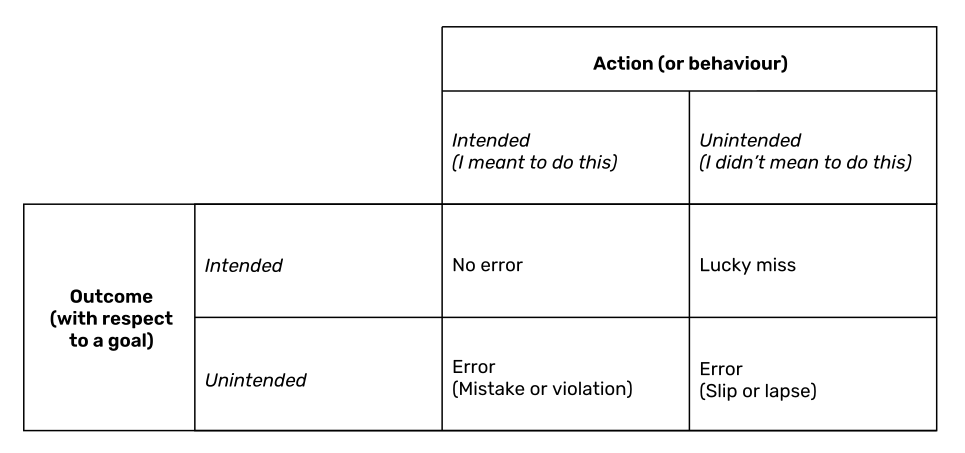
The concept of error can be defined in terms of what the person did (their action), and whether it was intentional or not and whether the outcome of their action was intended or not in that context. This relationship is summarised in Table 1. As shown, error in the form of slips and lapses occurs when an unintended action results in an unintended outcome. For example, swerving to avoid an animal on the road would be an error if it resulted in hitting an oncoming vehicle but if the unintended action (the swerve) results in the outcome intended (continuing driving with no impact) it would be a lucky or near miss. Slips are errors that result from an action-not-as-planned ‘(I didn’t mean to do it that way!’) whereas lapses are errors mainly resulting from memory failures (‘I forgot to do that’), both tending to occur when attention is directed away from the task at hand (Reason, 1990; 2008). In contrast, mistakes are errors of planning which occur when an intended action proceeds not as planned and results in an unintended outcome rather than what was intended (no error). Examples might include drifting slightly over the speed limit without realising or misjudging a gap when turning and cutting off another car unintentionally or braking too late when approaching a red traffic light when they misjudge their speed or distance to the car ahead.
Instances where intended behaviour involves a deliberate departure from a rule rather than a mistaken application of the rule, have been classified as Violations. These are a subtype of rule-based mistakes, where known or accepted rules are intentionally not applied. Violations are clearly not an error of behaviour because they are wilful but will obviously increase the risk of unintended outcomes.
Source: Authors (2026)
9. Violations, risky behaviour and deliberate risk-taking #
A great deal of road safety activity involves creating and applying rules that define safe road user behaviour, then using enforcement through fines, demerit points and licence removal to encourage and motivate road users to comply with the rules. It is not surprising then that a major focus of road safety is on reducing violations of rules for safe road use like speed limits, failure to wear seat belts and limiting alcohol use when driving. An early study in the UK by Reason, Manstead and colleagues (1990) developed an anonymous Driver Behaviour Questionnaire (the DBQ), which they used to survey over 500 drivers about their unsafe driving behaviour over the past year. The results showed three distinct driving behaviours: violations (such as close following or disregarding speed limits), errors in the form of slips and mistakes (like failing to see a ‘give way’ sign or to check mirrors before merging) or in the form of lapses (such as taking the wrong exit from a roundabout). These findings supported the idea that errors and violations have different mental origins. Further studies have reinforced these findings (eg., Parker, et al., 1995).
Violations are a form of risky or risk-taking behaviour as they each describe behaviour that occurs in spite of the increased risk of unsafe outcomes. Parker et al. (1995) define violations as deliberate infringements of some regulated or socially accepted code of behaviour. While violations are mostly associated with lack of compliance with rules and social norms for road use, risky behaviour and risk-taking can involve any behaviour that has been found to increase the likelihood of crashing. We would, almost by definition, expect risky behaviour to increase crashes, especially behaviour involving non-compliance with rules established for safety reasons. In addition, engaging in risky behaviour can contribute to other road users making errors.
9.1 Link between risky behaviour and crashes #
Studies of the link between self-reported risky behaviour and crashes show some support for this contention. Multiple studies using measures like the Driver Behaviour Questionnaire (DBQ) show that a higher self-reported tendency to commit driving violations predicts higher self-reported crash involvement (eg., Parker et al., 1995; de Winter & Dodou, 2010). Studies of the effects of driving styles also show that higher reported speeding or other dangerous actions are associated with higher crash risk (Sagberg et al., 2015). In the same vein, self-reported higher driving violations by fleet drivers were associated with higher reported fines and demerit points (Davey et al., 2007). In many of these studies, however, the size of the differences between drivers with high and low violations (effect sizes) and the amount of variation in crash outcomes accounted for by violations (variance accounted for) is only moderate at best, with most accounting for around 10% of variance in crash outcomes. For example, a meta-analysis of studies of the relationship between DBQ reports of violations and crash outcomes concluded that violations predicted self-reports of accidents with correlations of between 0.07 and 0.13 (de Winter & Dodou, 2010) and for the few studies using real recorded data on crashes, the correlations were even lower (0.05). It seems that the evidence of greater crash outcomes due to risky behaviour including violations may not be as strong as might be expected.
One possible explanation for this is that most of the studies of risky behaviour and crash outcomes involve self-report measures such as the Driver Behaviour Questionnaire, Aggressive Driving Scale (Deffenbacher, et al., 2016), the Sensation Seeking Scale (SSS) (Jonah, 1997) and the Behaviour of Young Novice Drivers scale (Scott-Parker et al., 2012). Self-report measures are known to be vulnerable to influences like social-desirability and to bias due to common method variance when both the potential cause and the effect measured, in this case risky behaviour and safety outcomes are collected using the same self-report methodology, often at the same time (Barraclough et al., 2014).
A few studies of the effect of risky behaviours have used objective measures of safety outcomes and self-reports of violations. A study by Thomas et al. (2025) attempted to validate the link between higher risky behaviour and crash risk by comparing self-reports using the DBQ of drivers committing violations against real-world driving, in this case speed selection and speeding using the UDRIVE naturalistic driving study data. First, they found that drivers’ self-reported data on speed selection was not consistent with their real-world behaviour. Drivers who reported never exceeding the speed limit in the DBQ spent 42 percent of time travelling at speeds above the speed limit when on highways, whereas those reporting speeding nearly all the time spent 55 percent of time above the limit. While driver reports of violations involving exceeding the speed limit were significantly correlated with actual speed on the road, the effect size was, again, very small so did not account for the higher speeding behaviour. Rather, the authors concluded other factors not measured in the study must be responsible.
Other studies using real crash data from naturalistic studies in other parts of the world showed similar findings for DBQ violations of small associations with crash involvement, such as Jaio et al. (2023) for China, as well as small to moderate associations with near-crash involvement and driving style (Wang & Xu, 2019). Further, a study by Martinussen et al. (2017) showed the tendency to commit violations (measured using the DBQ) predicted increased police-recorded driving offences but not accidents. Again, these studies using crash and offence data show relatively small effects of risky driving behaviour on crash risk.
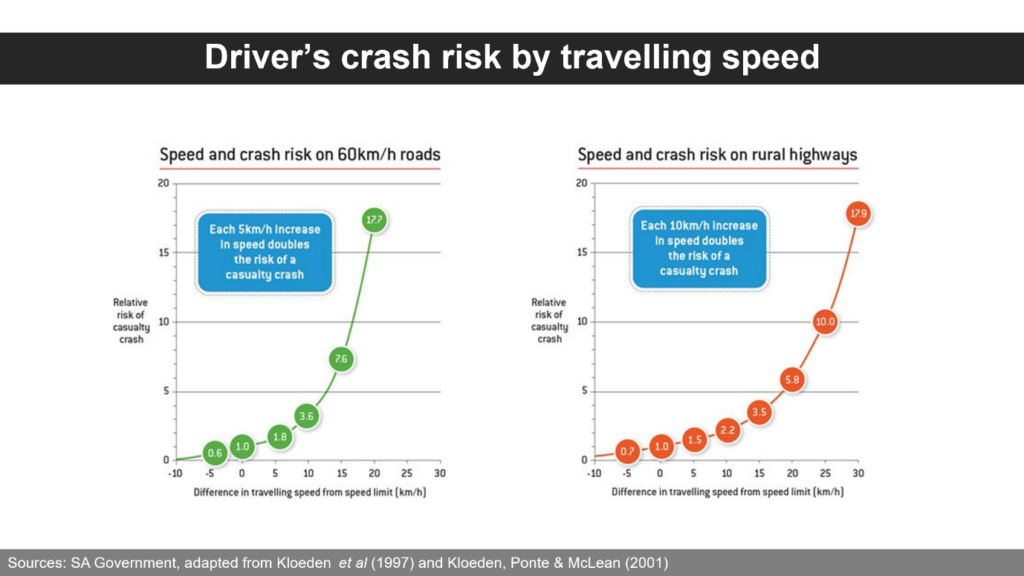
However, as described in the first chapter on road users, many studies have shown increased crash risk associated with specific risky driving behaviours like drink driving, drug driving, speeding, driving while fatigued, driving while using a phone (particularly texting). For example, there is good evidence from case-control studies on the effects of speeding. Research by Kloeden et al. (1997) found that the risk of involvement in casualty crashes doubled with every 5 km/h increase in speed above the limit on 60 km/h urban roads. Similar results were found by Kloeden et al. (2001) for 10 km/h increases in speed on 80 km/h rural roads. The findings of these studies are summarised in Figure 1 below.
Source: Kloeden et al. (2001)
Naturalistic driving studies also shed light on the crash risk associated with some of these key risky behaviours. For example, Dingus et al. (2016) using the large SHRP2 database in the US calculated the prevalence of different types of risky behaviours and the odds of crashes resulting. A summary of notable results from this analysis shows that all types of risky behaviours markedly increased the likelihood of crashing by at least a factor of two for observable distractions, up to 35 times for drug and alcohol impairment. Yet, the prevalence of most of these behaviours in normal driving was very low, being less than 1% for drug/alcohol impairment and following too closely, and just under 3% for speeding-related behaviours. The exception is observable distractions which were very common, occurring in just over half of driving sequences studied. Interpreting observable distractions as risky behaviour presents a problem, however. Whereas most of the other risky behaviours can be clearly defined as deliberately risky or violations, distractions while driving can occur without intention or even conscious awareness of the driver as discussed in the first part of this chapter.
| Risky behaviours | Odds ratio (95% CI) | Baseline prevalence |
| Observable distraction | 2.0 (1.8–2.4) | 51.93% |
| Drug/alcohol impairment | 35.9 (17.0–75.8) | 0.08% |
| Drowsiness/fatigue | 3.4 (2.3–5.1) | 1.57% |
| Speeding (over limit and too fast for conditions) | 12.8 (10.1–16.2) | 2.77% |
| Following too closely | 13.5 (4.4–41.4) | 0.07% |
Source: Adapted from Dingus et al. (2016)
Overall, the results from studies using self-reported risky behaviour and violations suggests that the association with crash risk is small at best, even when crash risk is estimated by self-report or actual crashes from naturalistic driving studies. Crashes can occur for multiple reasons, and risky driving behaviour may be just one. In addition, self-report measures of violations like the DBQ and its violation subscale(s) often represent an amalgam of aberrant driving behaviours, some of which are riskier than others. Indeed, the overall score that drivers are assigned using measures like the DBQ can depend on the mix of items included. This undoubtedly reduces the likelihood of finding links between self-reports of violation behaviours and crash risk. It must be remembered however, that studies of observed risky behaviours confirm that risky behaviours and violations increase crash risk, although the studies also found that these risky behaviours are quite infrequent in normal driving (eg., Victor et al., 2015). More research is needed to explore the contribution of risky behaviour in crashes.
9.2. Factors that increase risk-taking behaviour #
A large amount of research has focussed on the factors that encourage risky behaviour and violations, with many studies showing that the tendency for road users to take risks and commit violations is influenced by a range of different characteristics. The most consistent finding is the influence of age and gender on risky behaviour such that young drivers and males are markedly more likely to take risks and be involved in crashes while driving than older and female drivers (de Winter & Dodou, 2015). The earlier chapter in the road user part of the Road Safety Body of Knowledge already highlighted some of the main factors that can increase the likelihood of risky behaviour. These include the current state of road users such as the effects of alcohol and drugs, fatigue and distractions, as well as psychosocial influences like age and developmental, emotional and personality factors and cultural factors like peers, enforcement practices and social norms.
All these factors have been linked to increases in risky behaviour, but the mechanism of the effect can differ. Risky behaviour can occur for example if the focus of attention is changed such as if a driver misses the signage and exceeds the speed limit when their attention is diverted by other aspects in the road system or, as mentioned in the earlier chapter on psychosocial and cultural influences, when angry feelings divert the driver’s attention away from the primary task of driving (Tinella et al., 2026). Risky behaviours can also arise when circumstances in the driving situation evoke emotional responses like anger or frustration such as responding by increasing speed or tailgating, to being cut off by another driver (Tinella et al., 2026). Characteristics of individual road users like personality-related factors can increase risky behaviour. Personality traits that were discussed in the earlier chapter are a primary example, with overt personality traits, like excitement or adventure-seeking (Iversen & Rundmo, 2002; Machin & Sankey, 2008), playing a role in increasing risky behaviour in novice drivers. So too, the ability to control transient or dispositional emotional responses like anger, frustration has been associated with risky behaviour where poor emotional control may impede an individuals’ ability to make safe behavioural decisions when driving (Hayley et al., 2017).
Factors relating to how people perceive risk, the level of risk they are prepared to accept as well as their perception of the likelihood of detection and its consequences can all influence risky behaviour. Experiences like repeatedly engaging in risky behaviour such as speeding with no adverse consequences or seeing others do it, tend to make the risky behaviour more likely (Fleiter et al., 2010). Research on the predictors of drink driving, for example, found that individuals who reported that there was nothing wrong with driving after consuming alcohol, were more likely to drink drive (Hasan et al., 2023). Those who had experience of avoiding detection after drink driving were also more than four times more likely to continue with this risky behaviour). Research using the DBQ also found that drivers who commit more violations tend to underestimate the risk of negative consequences, perceive less social disapproval for committing violations, and report finding it difficult to manage violation-related behaviours (Parker et al., 1992). There is considerable research on the influence of punishment avoidance on risky driving behaviour (eg., Freeman & Watson, 2006; Scott-Parker et al., 2013).
There is also some evidence of individual differences in perceptions of risk summarised as ‘it won’t happen to me’ that have been linked with poorer judgments and increased risk-taking behaviour. Unrealistic optimism or “Optimism bias”, for example, is defined as a tendency to overestimate the likelihood of positive events and underestimate negative events (Shepperd et al., 2015). In contrast, the controllability of the consequences of the risky behaviour, known as the Illusion of control, is defined as the tendency to believe that negative events can be controlled by personal skill to a degree higher than objective probability would warrant (Thompson et al., 1998). Both types of biased perceptions have been linked to higher risk-taking behaviours by road users. Motorcyclists, for example, showed Optimism bias where they reported themselves less at risk than other motorcyclists of a serious accident in the next year (Rutter et al., 1998).
Many studies have shown Optimism bias in drivers who tend to underestimate their personal risk of crashes, although this interpretation has been challenged by research assessing driver’s perceptions of risk as a driver and their ability to control risk compared to their risk as a passenger, when they could not control risk (McKenna, 1993). Unrealistic optimism was only shown for the driver comparison, so indicating that the biased thinking was due to illusory perceptions about their control of risk rather than to optimism about its effects. More recent research looking at the contributions of optimism bias and the illusion of control of risk in self-reported aggressive driving behaviours supported this conclusion (Stephens & Otsukah, 2014).
Some other factors have been advanced to explain the underlying motivations that cause drivers to engage specifically in traffic violations and influence the decision to take risks while driving. This includes the role of moral disengagement, defined as a tendency to largely overlook the moral and ethical responsibilities associated with violations in traffic and to fail to comply with rules they perceive as morally wrong, whether formal traffic laws like speed limits or social norms like aggressive driving (Evans, 2008; Basiyd-Fellahi, et al., 2025). Research on moral disengagement has shown that the propensity to morally disengage is most common in driving rather than other everyday circumstances and that moral disengagement is a strong predictor of driving aggression (Swann et al., 2017). As Swann et al. (2017) explain, this might be expected since drivers are largely anonymous and driving involves only momentary interactions with unknown others, so making it more likely that they might behave in ways that contravene social norms like queue-jumping a line of traffic or invite censure from others such as speeding.
While many studies have looked for the factors that contribute to and promote risky behaviour, many factors account for comparatively small amounts of the variance in risky behaviour. A possible reason for this may be that risk-taking behaviour is caused by multiple factors. While most of these studies have treated risky behaviour as the result of a single factor, there is some awareness that this may be too simplistic. As pointed out by Hole (2007), it is far more likely that risky behaviour results from the interaction of multiple factors relating to the individual’s personality and their level of risk acceptance, the actual level of risk in the particular context, the person’s perception of risk (eg. novices vs experienced drivers) and lastly, their perception of the likelihood of detection and its consequences. While these factors may vary from situation to situation so an individual’s propensity to take risks may vary.
The concept of driving style has also been developed to explain risky driving. According to Elander et al. (1993), driving style is defined as the way a driver chooses to drive, or habitually drives, such as their choice of driving speed, headway and level of assertiveness and is distinguished from driving skill. Research on driving styles has identified different characteristic styles, two of which relate to risk-taking: reckless and careless driving and angry and hostile. The other two are anxious and patient and careful styles (Taubman-Ben-Ari, 2016; 2021). More recent studies have attempted to explore the interrelationships between driver characteristics and habitual driving behaviour (eg., Love et al, 2022; Love et al., 2024; Love & Truelove, 2026).
To complicate matters further, some research has demonstrated that different types of driving behaviours are predicted by different factors. Work by Fernandes et al. (2007) for example, showed that different risky behaviours like speeding, seat belt use and drink driving are not predicted in the same way by factors ranging from demographic, personality, and attitudes. This suggests that not only are risky behaviours explained by different factors, but the factors may also not contribute to risky driving in the same way as different risky behaviours have different mechanisms.
In summary, when considering the factors that cause risky behaviour, it is likely that multiple factors can play a role and that these factors often interact. In addition, it appears that risky driving is not a unitary phenomenon as when different types of risky behaviour are compared, they have different causes. We should not assume that all risky behaviour has similar origins.
10. Distinguishing risk, risk-taking and violations: the role of intention #
Finally, it is important to acknowledge that although most of the studies in this area focus on risky behaviour as a unitary entity, it is composed of different forms and that it is difficult in practice to distinguish violations and deliberate risk-taking from risky behaviour. While the role of intention is integral to violations and to risk-taking, it is acknowledged that both may occur unintentionally. Violations that occur without awareness of the rule have been classified as unintentional violations and categorised as error (Reason et al., 1990). Similarly, risky behaviour where the road user is unaware of the risk should be distinguished from risk-taking behaviour.
On the other hand, deliberate risk taking is intentional behaviour where the person knows and is aware that the behaviour is risky, but makes a calculated decision based on a particular purpose or goal. Most obviously, this behaviour can include violations where known rules are broken such as intentionally breaking speed limits. Much of our focus in road safety is on addressing intentional risk-taking and deliberate violations but in doing so we tend to assume that all apparently risky behaviour is a choice. This assumption overlooks that unintentional risky behaviour can look like risk taking when the person has low awareness or appreciation of risk with no conscious decision to take the risk. As explained, this type of behaviour can occur due to lack of knowledge, awareness or attention or due to lowered appreciation of risk when impaired by alcohol or drugs.
Differentiating deliberate from unintentional risk-taking or risky behaviour is not a trivial issue. Certainly, the origins of these behaviours are different so the strategies to manage them should be different. It is not always possible, however, to determine when risky driving behaviour is unintentional or deliberate. For example, driving at a speed above the legal limit is categorised as risky behaviour, but it may be unintentional where a driver is unaware of the legal limit when signage is obscured by vegetation, or if they missed the single sign when their focus of attention was on some other aspect of driving task, such as passing another vehicle. A driver can also misjudge the legal speed when the road system itself suggests higher speeds than allowed. Some risky behaviours that are managed and enforced through a formal law like drink-driving or speeding above a limit are more likely to involve intentional risk-taking (Reason, 1990). Attributing intention becomes more difficult for risky behaviours like fatigued driving or speeding not to the conditions where there are no formal rules, drivers can have more difficulty judging risk and the behaviour can be unintentionally risky.
Apparently deliberate risky behaviour can also occur when road users misunderstand the road rules. For example, Hatfield et al. (2007) conducted an observational study of pedestrians crossing at signal-controlled intersections in urban and rural settings, as well as surveys of pedestrians at the same crossings and drivers in the same vicinity. In these settings confusions about right-of-way may arise for pedestrians crossing during the Flashing Don’t Walk and Don’t Walk signals especially for left and right turning vehicles and for drivers who are facing a green signal but making the turn to left or right. The authors found a sizable minority of pedestrians (around 10 percent) crossed during the Don’t Walk in urban and rural settings, but the surveys showed misunderstanding of pedestrian right-of-way rules was common in various road-crossing situations. Both behavioural and survey results suggested that pedestrian right-of-way was erroneously thought to be influenced by the pedestrian signal at signal-controlled intersections and survey results also showed confusion regarding right-of-way at crossings. The apparent risk-taking behaviour for these pedestrians was more likely to be due to misunderstanding of rules than intentional behaviour.
Factors like these make it difficult to distinguish deliberate risk-taking behaviour from risky behaviour. There can be legitimate reasons for road users to undertake risky behaviour without it being an active choice to take the risk. In addition, a proportion of apparently risky behaviour is inadvertent and should not be assumed to be deliberate. Much of the evidence cited in this section is based on studies of the causes and consequences of risky behaviour, but this is too simplistic and may be a further reason for the findings of small effect sizes in many studies. The mechanisms behind risky, risk-taking and violation behaviours differ on some important elements, especially awareness of the consequences of the behaviour for personal safety, the legal consequences and the road user’s intention. Violations of established rules and social norms are clearly risk-taking behaviour providing the rule is known and understood by all road users. In these cases, the road user accepts the risk of safety and legal consequences of the violation behaviour and the behaviour is intended. For risk-taking behaviour not involving such clearly defined risky behaviour, intention may not play a role where the behaviour is habitual, and the person is not aware of the safety risk when doing so or may be unaware of the legal consequences of the behaviour if they are not aware of it being tested. An example is the not-uncommon practice of driving with one hand on the steering wheel which could compromise safety in many circumstances and so be judged as risky. While road law usually requires drivers to drive with proper control of the vehicle, there is generally no specific law requiring drivers to maintain both hands on the steering wheel while driving. Drivers who do so could be judged to be taking risks, but the behaviour is not necessarily risk-taking or intentional risky behaviour.
11. Summary: Risky behaviour and crashes #
In conclusion, risky behaviour is often argued to play a predominant role in the causes of crashes. Recent research suggests this may not be the case. For example, research by Wundersitz & Raftery (2025) in Australia examined the role of extreme behaviour or violations in 157 fatal crashes (2014-2015) and 235 non-fatal injury crashes (in which at least one person was admitted to hospital) in South Australia. Violations or ‘extreme behaviour’ such as driver’s BAC 0.15% or higher, driver going 50% faster than the speed limit and pedestrians with BAC 0.20% or more were found in only around 30% of fatal crashes and around 7% of injury crashes involved. Similarly, Swedish research by Rizzi et al. (2023) analysed and coded every fatal crash in Sweden in the three years 2016–2018 according to three categories: Group 1 – Mistake; Group 2 – Lack of Protection (mainly non-seat belt wearing) and Group 3 – deliberate violations (mainly severe speeding, reckless driving, and red-light running). About two-thirds of the fatal injuries were attributed to everyday road users making everyday mistakes. Only 18% of fatalities related to deliberate and severe violations of traffic rules. Between a further 10-16% related to lack of personal safety equipment like seat belts and helmets which are also violation behaviours in countries where they are mandatory (like Sweden) although this behaviour would contribute to crash mitigation, not to crash occurrence.
These studies examining the proportion of fatal crashes involving risky behaviour indicate that the contribution of risky and violating behaviour is less overall than mistakes or misjudgments of the type described in the first part of this section. This is not to say, however, that when an individual road user engages in risky behaviour that violates rules for safety that there is no impact on their risk of crashing. As described in this and the earlier part of the chapter on Users in road safety, there is a considerable body of evidence demonstrating heightened crash risk when drivers engage in key risky driving behaviours like drink driving, drug driving, and speeding.
Currently, however, there are limits to our understanding of the actual role of risky behaviour in crashes. This is due to the high proportion of self-report studies of both the risky behaviour of interest and safety-related outcomes so effect sizes for the role risky behaviour in crashes have tended to be considerably smaller than is generally believed. This problem is enhanced by the large number and broad nature of the research on factors that encourage risky behaviour. Very few studies have attempted to look more deeply at the interactions between factors, nor at how they may influence risk assessment or risk perception which in turn affects whether the risk-taking behaviour is a personal judgement by the road user or is judged only in terms of formal road safety law.
Lastly, our understanding of the role of risky behaviour is greatly hampered by the implicit assumption in so many studies that all risky behaviours are the same. There are clear distinctions in types of risky behaviour relating to intention and awareness of risk. Ignoring these differences between types of risky behaviour seriously hampers our understanding of the causes and effects of risky behaviour. Progress in understanding and addressing risky behaviour in road safety will depend on whether further research overcomes these problems. We must do this because understanding when and why risky behaviour occurs is essential for developing effective strategies to address this type of behaviour.
12. Conclusions: The role of error and risk-taking in road safety #
Errors are a common feature of human life, including for road users. Road user errors and other unsafe behaviours including risk-taking contribute to many road crashes. Errors, however, are not unavoidable. Errors can be made more common when the situation for road users presents difficulties for them to understand or to process, the road system is unclear or confusing, or if the situation demands behaviour that is beyond their level of skill or their experience. Errors can be the result of people being consciously or deliberately careless, inattentive or recalcitrant, but not always. Too often in road safety we assume that errors by road users are inevitable rather than recognising that a great deal can be achieved towards enhancing safety outcomes by ensuring that the road system, including roads, vehicles, laws, enforcement, training and education, is primarily usable for all users. It is essential to understand the wide range of factors influencing road user error and other unsafe or risky behaviours both unintentional and intentional, to inform effective prevention efforts. This was a key rationale for this chapter. To this end, Behavioural Interventions chapter of the Road Safety BoK covers the area of behavioural interventions that aim to prevent road user errors and risk-taking behaviour.
It is important to acknowledge that aspects of the road system such as some laws and enforcement strategies, can influence road user behaviour by tolerating and even encouraging intentional risky behaviour in the road system. Examples include inconsistent testing for drink driving or enforcement tolerances for speeding which reduce driver perception that they are likely to be caught. As explored in this chapter, intentionally risky behaviour can play a role in road crashes. Interventions are needed to specifically target these types of behaviours.
We need to revise our conception of error as the primary cause of crashes in road safety and begin to ask the question: why did the road user behave in that way at that time? Understanding when, how and why road users make errors is key to preventing them. Attributing crashes to driver error without checking for the role of upstream design, regulatory, and organisational decisions obscures institutional responsibility and weakens accountability mechanisms necessary for sustained safety improvement.
13. References #
Barraclough, P., af Wåhlberg, A., Freeman, J., Davey, J. & Watson, B. (2014). Real or imagined? A study exploring the existence of common method variance effects in road safety research. In S. Landry, N. Stanton, A. Vallicelli & G. Di Bucchianico (Eds.), Advances in Human Aspects of Transportation – Part 1 Proceedings of the 5th International Conference on Applied Human Factors and Ergonomics (pp. 313-327). AHFE International, Poland. https://eprints.qut.edu.au/76184/17/76184.pdf
Basiyd-Fellahi, H., Delhomme, P. & Cestac, J. (2025). Exploring the link between traffic violations and moral disengagement: A scoping review. Transportation Research Interdisciplinary Perspectives, 31, 101438. https://www.sciencedirect.com/science/article/pii/S2590198225001174
Davey, J., Wishart, D., Freeman, J. & Watson, B. (2007). An application of the driver behaviour questionnaire in an Australian organisational fleet setting. Transportation Research Part F: Traffic Psychology and Behaviour, 10(1), 11-21.
Deffenbacher, J. L., Stephens, A. N. & Sullman, M. J. (2016). Driving anger as a psychological construct: Twenty years of research using the driving Anger Scale. Transportation Research Part F: Traffic Psychology and Behaviour, 42, 236-247.
de Winter, J.C.F., & Dodou, D. (2010). The Driver Behaviour Questionnaire as a predictor of accidents: A meta-analysis. Journal of Safety Research 41(2010), 4630470.
de Winter, J. C. F., Dodou, D., Stanton, N. A., (2015). A quarter of a century of the DBQ: some supplementary notes on its validity with regard to accidents. Ergonomics, 58, 1745–1769. http://dx.doi.org/10.1080/00140139.2015.1030460
de Winter J.C.F., Dreger F.A., Huang W., Miller A., Soccolich S., Ghanipoor Machiani S. & Engström J. (2018). The relationship between the Driver Behavior Questionnaire, Sensation Seeking Scale, and recorded crashes: A brief comment on Martinussen et al. (2017) and new data from SHRP2. Accident Analysis & Prevention, 118, 54-56.
Dingus, T. A., Guo, F., Lee, S. E., Antin, J., Perez, M., Buchanan-King, M. & Hankey, J. (2016). Driver crash risk factors and prevalence evaluation using naturalistic driving data. Proceedings of the National Academic of Sciences, 113(10), 2636-2641. https://doi.org/10.1073/pnas.1513271113.
Doecke, S. D., Thompson, J. P., & Stokes, C. S. (2020). How do we prevent and mitigate crashes? Evidence from Australian at-scene in-depth crash investigations. Journal of Road Safety, 31(2), 35-43. https://search.informit.org/doi/10.3316/informit.331219715712215
Elander, J., West, R., & French, D. (1993). Behavioral correlates of individual differences in road-traffic crash risk: An examination of methods and findings. Psychological Bulletin, 113(2), 279-294. https://doi.org/10.1037/0033-2909.113.2.279
Evans, L. (2008). Death in Traffic: Why Are the Ethical Issues Ignored? Studies in Ethics, Law, and Technology, 2(1). https://www.degruyterbrill.com/document/doi/10.2202/1941-6008.1014/html
Fernandes, R., Job, R. F. S., & Hatfield, J. (2007). A challenge to the assumed generalizability of prediction and Countermeasure for risky driving: Different factors predict different risky driving behaviours. Journal of Safety Research 38, 59-70.
Fitzharris, M., Lenné, M., Corben, B., Pok Arundell, T., Peiris, A., Liu, S., Stephens, A. N., Fitzgerald, M., Judson, R., Bowman, D., Gabler, H., Morris, A., & Tingvall, C. (2020). Overview and analysis of serious injury crashes – crash types, injury outcomes and contributing factors. ECIS Report 1 (Report No. 343) (V. 3). Monash University Accident Research Centre. https://doi.org/10.26180/23305325.v3
Fleiter, JL., Lennon, A., Watson, B. (2010). How do other people influence your driving speed? Exploring the ‘who’ and the ‘how’ of social influences on speeding from a qualitative perspective. Transportation Research Part F 13, 49-62.
Freeman, J., & Watson, B. (2006). An application of Stafford and Warr’s reconceptualization of deterrence to a group of recidivist drink drivers. Accident Analysis & Prevention, 38(3), 462-471.
Gregersen, N. P., & Nyberg, A. (2003). Driver behaviour when changing from right‑hand to left‑hand traffic: A naturalistic study. Accident Analysis & Prevention, 35(4), 477-486.
Hasan, R., Watson, B., Haworth, N. & Oviedo-Trespalacios, O. (2023). The self-reported psychosocial and legal factors contributing to drink and drug driving. Transportation Research Part F: Traffic Psychology and Behaviour, 98, 186-204.
Hatfield, J., Fernandes, R. Job, R. F. S., & Smith, K. (2007). Misunderstanding of right-of-way rules at various pedestrian crossing types: Observational study and survey. Accident Analysis & Prevention 39, 833-842.
Hauer, E., (2020). Crash causation and prevention. Accident Analysis & Prevention, 143, 1-13. https://doi.org/10.1016/j.aap.2020.105528
Hayley, AC., de Ridder, B., Stough, C., Ford, T. C., & Downey, L. A. (2017). Emotional intelligence and risky driving behaviour in adults. Transportation Research Part F 49, 124-131
Hole, G. (2007). The psychology of driving. Lawrence Erlbaum.
International Civil Aviation Organization. (2018). Safety Management Manual (SMM) (Publication No. 9859) (4th ed.). https://www.icao.int/safety-management/SMI/SMM
Iversen, H., & Rundmo, T. (2002). Personality, risky driving and accident involvement among Norwegian drivers. Personality and Individual Differences, 33(8), 1251-1263. https://doi.org/10.1016/S0191-8869(02)00010-7
Jiao, Y., Wang, X., Hurwitz, D., Hu,G., Xu, X. & Zhao, X. (2023). Revision of the driver behavior questionnaire for Chinese drivers’ aberrant driving behaviors using naturalistic driving data. Accident Analysis & Prevention, 187, 107065
Jonah, B. A. (1997). Sensation seeking and risky driving: A review and synthesis of the literature. Accident Analysis & Prevention, 29(5), 651-665. https://doi.org/10.1016/S0001-4575(97)00017-1
Kloeden, C. N., McLean, A. J., Moore, V. M. & Ponte, G. (1997). Travelling speed and the risk of crash involvement (Report No. CR172). Federal Office of Road Safety.
Kloeden, C. N., Ponte, G. & McLean, A. J. (2001). Travelling Speed and the Risk of Crash Involvement on Rural Roads (Report No. CR 204), 1-46. Department of Transport and Regional Services, Australian Transport Safety Bureau.
Love, L. Kannis-Dymand, L., Davey, J., Freeman, J. (2022). Risky driving and lapses on the road: An exploration on self-regulatory dysfunction in Australian drivers. Transportation Research Part F, 88, 25-36.
Love, S., Rowland, B., & Davey, J. (2023). Exactly how dangerous is drink driving? An examination of vehicle crash data to identify the comparative risks of alcohol-related crashes. Crime Prevention Community Safety 25, 131-147. https://doi.org/10.1057/s41300-023-00172-6
Love, S., & Truelove, V. (2026). The role of driver profiles in speeding deterrence: Examining interactions between speeding, personality, and risk perceptions. Journal of Safety Research, 97, 207-217.
Machin, M. A., & Sankey, K. S. (2008). Relationships between young drivers’ personality characteristics, risk perceptions, and driving behaviour. Accident Analysis & Prevention, 40(2), 541–547. https://doi.org/10.1016/j.aap.2007.08.010
Martinussen, L. M., Møller, M., Prato, C. G., & Haustein, S. (2017). How indicative is a self-reported driving behaviour profile of police-registered traffic law offences? Accident, Analysis & Prevention, 99, 1-5. https://doi.org/10.1016/j.aap.2016.10.031
McKenna, F. P. (1993). It won’t happen to me: Unrealistic optimism or illusion of control? British Journal of Psychology, 84(1), 39–50.
Möller, H., Cullen, P., Senserrick, T., Rogers, K., Boufous, S., & Ivers, R. Q. (2022). Driving offences and risk of subsequent crash in novice drivers: the DRIVE cohort study 12‑year follow‑up. Injury Prevention, 28(5), 396–404.
Norman, D. (2013). The Design of Everyday Things. Basic Books. https://dl.icdst.org/pdfs/files4/4bb8d08a9b309df7d86e62ec4056ceef.pdf
Oppenheim, I., & Shinar, D. (2011). Human factors and Ergonomics. In B. E. Porter (Ed.), Handbook of Traffic Psychology. Academic Press.
Parker, D., Reason, J. T., Manstead, A. S. R., & Stradling, S. G. (1995). Driving errors, driving violations and accident involvement. Ergonomics, 38(5), 1036-1048. https://doi.org/10.1080/00140139508925170
Parker D., Manstead, A. S., Stradling, S. G. & Reason, J. T. (1992). Determinants of intention to commit driving violations. Accident, Analysis & Prevention, 24(2), 117-121.
Rasmussen, J. (1983). Skills, rules and knowledge: Signals, signs and symbols and other distinctions in human performance models. IEEE Transactions on Systems, Management and Cybernetics, SMC-13(3), 257-266.
Reason, J., Manstead, A., Stradling, S., Baxter, J. & Campbell, K. (1990). Errors and violations on the roads: a real distinction?. Ergonomics, 33(10-11), 1315-1332.
Reason, R. (1997). Managing the risks of organisational accidents. Ashgate Publishing Co.
Reason, J. (2008). The human contribution. Unsafe acts, accidents and heroic recoveries. Ashgate Publishing Co.
Rizzi, M., Fredriksson, R., & Krafft, M. (2023). Government Status Report Sweden, 2023. In Proceedings of the 27th Enhanced Safety of Vehicles Conference, Yokohama, Japan.
Rutter, D. R., Quine, L. & Albery, I. P. (1998). Perceptions of risk in motorcyclists: Unrealistic optimism, relative realism and predictions of behaviour. British Journal of Psychology, 89, 681-696. https://doi.org/10.1111/j.2044-8295.1998.tb02710.x
Sagberg, F., Selpi, G., Piccinini, F. B. & Engstrom, J. (2015). A review of research on driving styles and road safety. Human Factors, 57(7), 1248-1275. https://doi.org/10.1177/0018720815591313
Scott-Parker, B., Watson, B., King, MJ., Hyde, MK. (2012). Confirmatory factor analysis of the Behaviour of Young Novice Drivers Scale (BYNDS), Accident Analysis & Prevention, 49, 385-391. https://doi.org/10.1016/j.aap.2012.02.021
Scott-Parker, B., Watson, B., King, M. J. & Hyde, M. K. (2013). Punishment avoidance and intentional risky driving behaviour: What are the implications for ‘getting away with it’? In N. Castro (Ed.), Psychology of Punishment: New Research (pp. 55-77). Nova.
Shepperd, J. A., Waters, E. A., Weinstein, N. D., & Klein, W. M. P. (2015). A Primer on Unrealistic Optimism. Current Directions in Psychological Science, 24(3), 232-237.
Shinar, D. (2019). Crash causes, countermeasures, and safety policy implications. Accident Analysis & Prevention, 125, 224-231.
Singh, S. (2015). Critical reasons for crashes investigated in the National Motor Vehicle Crash Causation Survey (Report No. DOT HS 812). National Highway Traffic Safety Administration, US Department of Transportation. https://crashstats.nhtsa.dot.gov/Api/Public/ViewPublication/812506
Singh, S. (2018). Critical reasons for crashes investigated in the National Motor Vehicle Crash Causation Survey – Traffic Safety Facts (Report No. DOT HS 812 506). National Highway Traffic Safety Administration, US Department of Transportation.
Stephens, A. N., & Ohtsuka, K. (2014). Cognitive biases in aggressive drivers: Does illusion of control drive us off the road?. Personality and Individual Differences, 68, 124-129. https://doi.org/10.1016/j.paid.2014.04.016.
Swann, A. Lennon, A., & Cleary, J. (2017). Development and preliminary validation of a scale of driving moral disengagement as a tool in the exploration of driving aggression. Transportation Research Part F: Traffic Psychology and Behaviour, 46(A) 124-136. https://doi.org/10.1016/j.trf.2017.01.011.
Taubman-Ben-Ari, O., & Skvirsky, V. (2016). The multidimensional driving style inventory a decade later: Review of the literature and re-evaluation of the scale. Accident Analysis and Prevention, 93, 179-188.
Taubman-Ben-Ari, O. (2021). Transport Psychology: The Multidimensional Driving Style Inventory. International Encyclopaedia of Transportation. http://dx.doi.org/10.1016/B978-0-08-102671-7.10658-X
Thomas, P., Welsh, R., Morris, A. & Reed, S. (2025). Validating self-reported driving behaviours as determinants of real-world driving speeds. Ergonomics, 68(8), 1192-1206.
Thompson, S. C., Armstrong, W., & Thomas, C. (1998). Illusions of control, underestimations, and accuracy: A control heuristic explanation. Psychological Bulletin, 123(2), 143–161. https://doi.org/10.1037/0033-2909.123.2.143
Tinella, L., Bosco, A., Koppel, S., Traficante, S., Ricciardi, E., Napoletano, R., Spano, G., Cozzolino, M., Lopez, A., & Caffò, A. O. (2026). What triggers anger behind the wheel? An invariance study on personality traits and risky attitudes in Italian and Australian older drivers. Journal of Safety Research, 96, 148-159.
Victor, T., Dozza, M., Bargman, J., Boda, C. N., Engstrom, J., Flanagan, C., Lee, J. D., & Markkula, G. (2015). Analysis of Naturalistic Driving Study Data: Safer glances, driver inattention and crash risk. National Academies of Sciences, Engineering, and Medicine. The National Academies Press.
Wanga, X., Xu, . (2019). Assessing the relationship between self-reported driving behaviors and driver risk using a naturalistic driving study. Accident Analysis and Prevention, 128, 8-16.
Williamson, A. (2021). Why do we make safe behaviour so hard for drivers?. Journal of Road Safety, 32(1), 24-36. https://journalofroadsafety.org/article/32212-why-do-we-make-safe-behaviour-so-hard-for-drivers
Woods, D. D., Dekker, S., Cook, R., Johannesen, L., & Sarter, N. (2010). Behind human error (2nd ed.). Ashgate Publishing.
Wundersitz, L. N. & Raftery, S. J. (2025). System Failures and Extreme Behaviour in Fatal and Injury Crashes in South Australia. Traffic Injury Prevention, 26(7), 1-9. https://doi.org/10.1080/15389588.2025.2454945